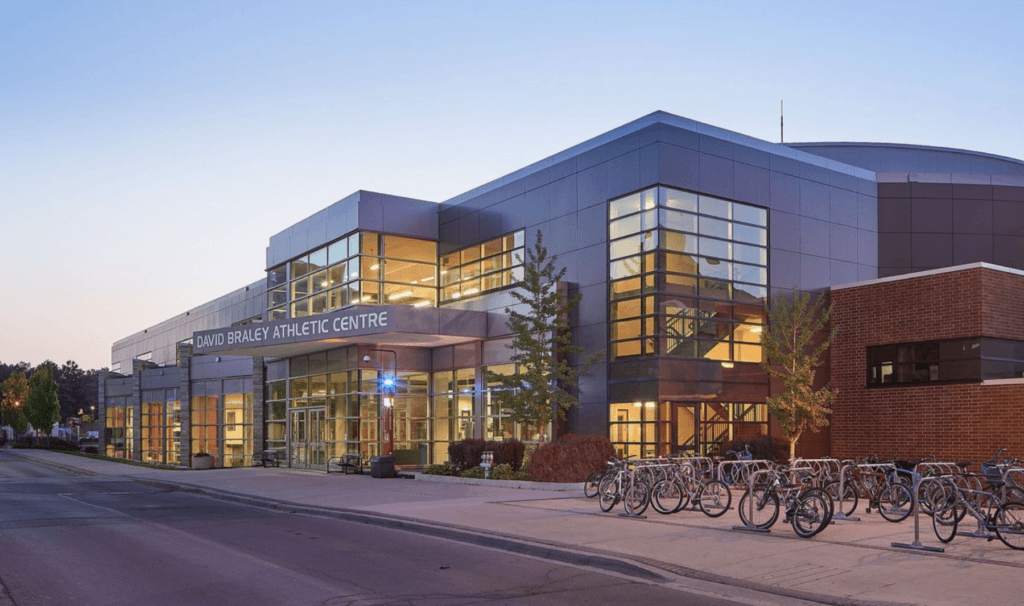
Celebrating its 20th anniversary, the David Braley Athletic Centre stands as the result of a student-backed vision, community support and a belief that McMaster could build something for everyone.
By Jay Barlett, Communications & Media Specialist, Athletics & Recreation
Not long after the David Braley Athletic Centre opened, Thérèse Quigley was working late in her office when Les Miller came looking for her.
“You’ve got to come,” he told her. “There’s something you have to see.”
Miller, then McMaster Athletics & Recreation’s manager of operations, led Quigley across to the new Sport Hall. When they arrived, the space was packed.
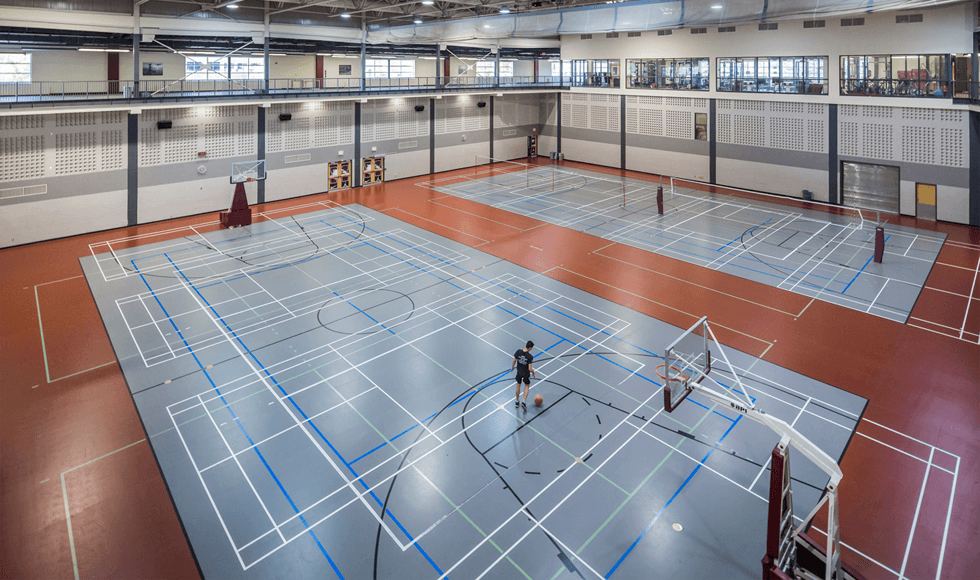
Students had lined the perimeter of the gym. Hundreds of them, Quigley remembers, each holding a badminton racquet and waiting for their chance to become some of the first students to use a facility years in the making.
For Quigley, McMaster’s athletics and recreation director at the time and one of the driving forces behind the project, it was the kind of moment that made all of the planning, fundraising, redesigns and delays suddenly feel worth it.
Miller looked at her. “Build it and they will come,” he said.
Twenty years later, they are still coming in record numbers.
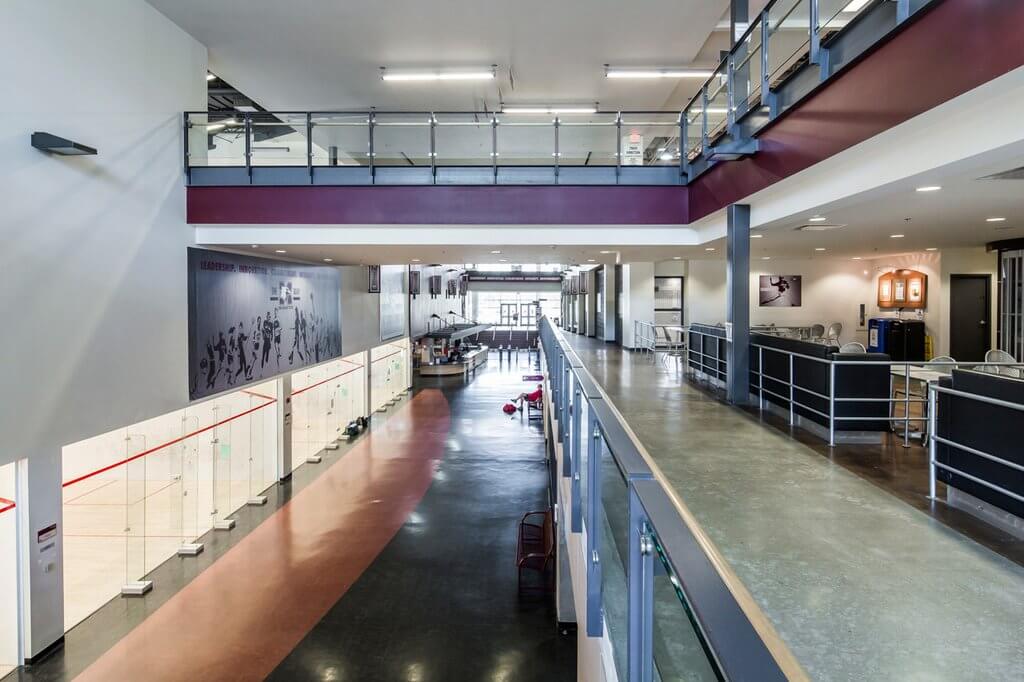
For a generation of McMaster students, the David Braley Athletic Centre — or DBAC as it’s well known — has simply always been there: the Pulse, Sport Hall, indoor track, squash courts, climbing wall, studios and Sport Medicine and Rehabilitation Centre are woven into daily campus life.
It is easy, from that vantage point, to forget how different things once looked.
Trish Chant-Sehl, now McMaster’s Associate Director, Recreation & Healthy Living, remembers well.
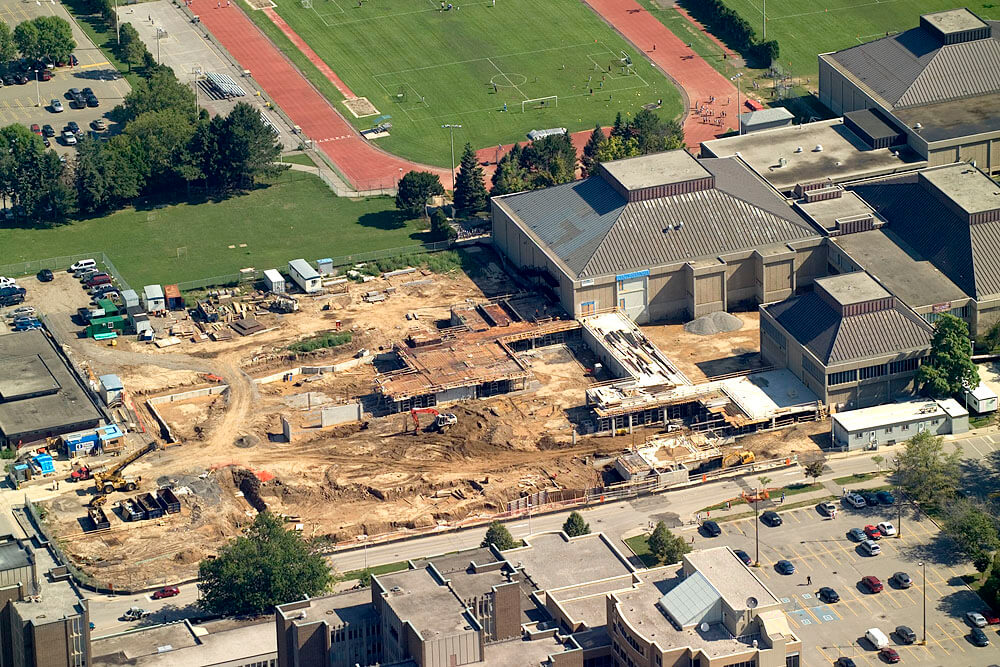
In the 1990s, Athletics & Recreation operated primarily from the Ivor Wynne Centre, with Les Prince Field, the university’s primary competition field, sitting where DBAC stands today. Fitness space was limited to say the least. Recreation and varsity programs were always competing for the same gymnasiums, and those spaces would also disappear during exam periods.
The fitness area Chant-Sehl remembers from her student days was in the basement of Ivor Wynne: concrete, cramped and sparse – affectionately dubbed, ‘the dungeon.’
Later, when a former gymnastics space in one of the auxiliary gymnasiums was converted into an early version of what would become the Pulse Fitness Centre, it felt transformative.
“We thought we’d all won the lottery,” she said.
But McMaster was growing, student interest in fitness and wellness was growing with it, and the existing facilities simply could not keep pace.
“We didn’t have enough space to meet the demands for both recreation and varsity,” Chant-Sehl said.
What the department needed wasn’t simply more square footage. It needed recreation space students could count on — space that would remain available even when varsity schedules intensified or other campus demands, including exams, took over existing gymnasiums.
For Quigley, the need for something larger had been apparent long before the project took shape.
She arrived at McMaster in 1984 after working at the University of Alberta, where major international events such as the Commonwealth Games and World University Games had driven substantial investment in athletic facilities.
What she saw there shaped what she believed was possible at McMaster.
By the time she became athletic and recreation director in 1990, the goal was increasingly clear: create enough capacity that recreation and varsity sport no longer had to fight for the same space.
“The goal was to create something for everyone,” Quigley said.
That meant thinking beyond a single building. DBAC, the redevelopment of the Ivor Wynne Centre and the stadium project that would eventually become Ron Joyce Stadium, were all pieces of a broader vision for an athletics and recreation complex capable of serving a highly active student body and a successful athletic program at the same time.
And, Quigley is quick to point out, it “all began with the student body.”
Before there was a major fundraising campaign, before David Braley’s name was attached to the building, and before students could walk into the new Sport Hall, McMaster needed current students to agree to help pay for a facility many of them would never use.
Chant-Sehl, who had joined the department full-time in 1998, became one of the point people for the student referendum.
“It was really clear early on it had to be the positive messaging, not negative,” she said. “It was like, ‘This is what you can get if we support this project.’”
The proposed contribution was broken down into something tangible: $2 per course unit, to a maximum of 30 units — roughly $60 per year for a full-time student.
Then came the campaign.
A&R staff worked with faculties and the McMaster Students Union. Student-athletes were encouraged not only to vote, but to bring their friends. Chant-Sehl and others went into classrooms in the mornings armed with transparencies explaining what students would be signing on for, how it would improve their experience, what it would cost and when they could vote.
“We put a lot of thought into, ‘How are we going to get to a yes?’” Chant-Sehl said. And when all was said and done, they got a pretty resounding one.
What stands out to her now is that students understood they were largely voting for somebody else’s future. The referendum took place years before the building would open, and many of those who voted yes and helped to take on the cost knew they would graduate before ever setting foot inside it.
That student commitment gave the project an important foundation. But realizing the larger vision would take far more.
When Quigley first approached Ron Foxcroft about the scale of the campaign, she told him McMaster needed approximately $30 million to bring this vision to life. Foxcroft remembers his response.
“I said, ‘Well, Thérèse, I think you’re out of your mind. I don’t think we can raise $30 million.’”
Six months later, Quigley returned saying “well, I kind of think it’s $50 million.”
Foxcroft laughed remembering it.
“I said, ‘that validates the fact that you’re out of your mind.’”
Not long afterward, he agreed to chair the fundraising campaign, seeing it as an opportunity to help give back to the community that he credits with launching his professional career.
Foxcroft and the university’s advancement team travelled throughout North America meeting donors and learning from other major university athletic campaigns. McMaster’s campaign, unlike some of the major projects they visited in the U.S., would need to rely on a broad network of alumni, staff, community supporters and donors, some making transformational gifts and others contributing what they could.
Quigley remembers that breadth of support as one of the defining features of the campaign.
The Joan Buddle Service Desk inside DBAC, for example, was not named through a massive individual donation. Staff, faculty, students and members who knew Buddle from her many years working in the women’s locker room contributed to honour her.
“There were very, very significant gifts,” Quigley said, “right through to the gifts that people gave because … so many staff and alumni and students were truly engaged in the project.”
“It takes a village to build something big,” she added. “This was very much the case.”
Foxcroft’s pitch to donors was rooted in something larger than athletics.
“McMaster mattered to Hamilton,” he said. “If McMaster is healthy, Hamilton is healthy.”
The campaign argued that investing in Athletics & Recreation was an investment in people — future leaders, athletes and students — while also strengthening McMaster’s profile nationally.
The facilities they had, Foxcroft said, were no longer up to the standard of the programs using them.
“We’ve got these amazing leaders, we’ve got these amazing student-athletes, and now we need a facility so that they can achieve,” he said.
One of the most important supporters was David Braley.
Braley had deep connections to McMaster University, sports and Hamilton. A McMaster student and member of the 1963-64 Marauder football and basketball teams, he and Foxcroft were close friends for decades, regularly attending McMaster games together. Foxcroft remembers fondly their nearly 50-year friendship, and for the duration, a standing weekly phone call. Quigley had also developed a strong relationship with Braley through athletics and major sporting events in Hamilton.
But it would become apparent that Braley’s support for McMaster Athletics & Recreation went beyond just wanting to contribute to building an athletic centre.
For Colleen Cupido, that proved crucial.
Cupido had first experienced McMaster sport medicine as a Marauder student-athlete. At the time, she remembers what was essentially a small athletic therapy space in a room off Burridge Gymnasium: a couple of treatment tables, an ice machine, hot packs and one part-time athletic therapist providing pre- and post-practice care.
“It wasn’t a full operational clinic, that’s for sure,” she said.
After completing her physiotherapy education at McMaster and working in private practice, Cupido was recruited back as the department’s first dedicated physiotherapist.
She immediately saw what the existing model could become.
“The goal was to create a centre of excellence for clinical care, education and research,” Cupido said. “There wasn’t anything of its kind in Hamilton at the time.”
Her vision was multidisciplinary: physiotherapists, sport medicine physicians, massage therapists, orthopedic surgeons and other specialists working together under one roof.
And it was never intended to serve varsity athletes alone. Students, faculty, staff and community members were part of the model from the beginning.
Cupido wanted a six-year-old gymnast, a young squash player, a weekend warrior and a Marauder varsity student-athlete to receive the same standard of care.
It was an idea eventually captured in a simple philosophy: everyone would be treated like a Marauder.
And it was Quigley that gave Cupido room to pursue that vision.
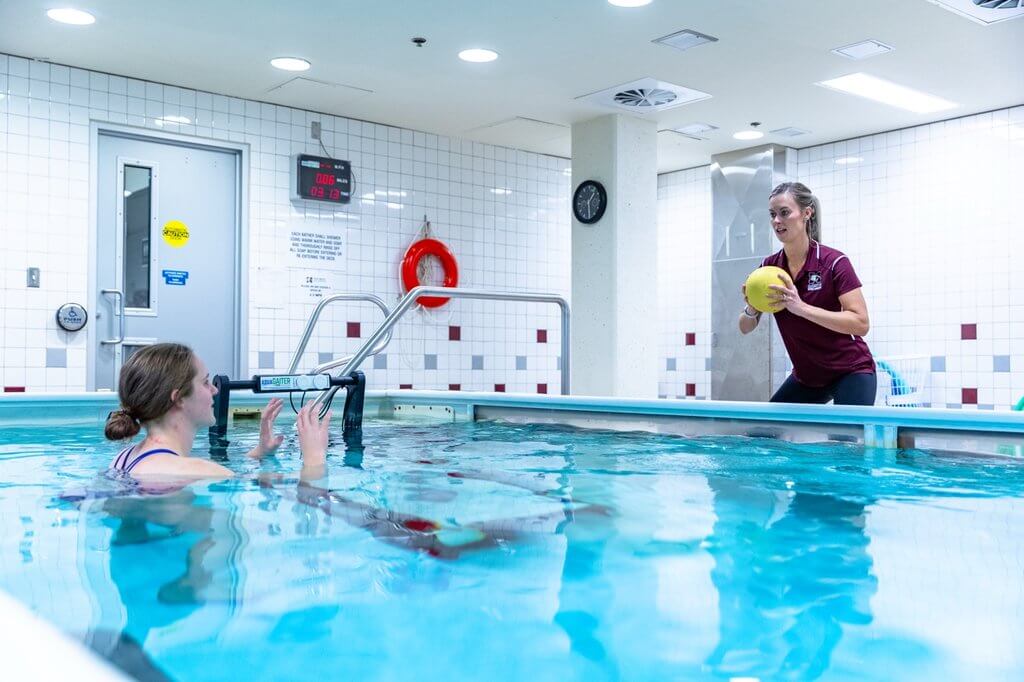
When Cupido learned about a new underwater treadmill technology being used for rehabilitation at universities in Florida, Quigley sent her south to investigate.
Cupido visited Florida State and the University of Florida, studied the facilities and returned with a plan. McMaster eventually incorporated hydrotherapy and an underwater treadmill into its new Sport Medicine facility, creating opportunities not only for rehabilitation but for research into how those tools could improve recovery from injuries such as ACL tears.
For Cupido, that intersection of clinical care, teaching and research is what separated the centre.
“We knew that in order to be a world-class clinic, we needed to have the space,” she said. “And I think the thing that also separated us was the research component.”
Student physiotherapists, medical students, kinesiology students and fellows could learn inside the centre and gain hands-on experience in a high-performance environment. Some would later return as practitioners.
“Excellence bred excellence,” Cupido said.
And Braley understood that ambition.
Cupido remembers him asking what it would take to make the facility one of the best in Canada. Foxcroft remembers Braley calling him one day and asking how quickly he could get to his office.
“Get over here,” Braley told him. When Foxcroft arrived, Braley had his cheque book out.
“Youth and sport medicine is really important,” Foxcroft remembers him saying.
The support reflected something several of those involved in the project remember about Braley: he was interested not simply in buildings, but in what those buildings could enable.
Quigley remembers him as someone interested in excellence and high performance who also understood the impact healthy living could have well beyond varsity sport.
He also insisted that his own philanthropy not diminish anyone else’s contribution.
“He wanted to make sure that everyone, regardless of their gift, regardless of how much they were giving, that they were not overshadowed by his gift,” Quigley said.
For Quigley, that instinct said something about Braley himself, but it also reflected the spirit in which the entire project had come together. His was among the largest gifts, but DBAC was never the product of one donor, one administrator or one group.
Students had agreed to invest in a facility many of them would never use, so future students could thrive. Staff and alumni had given what they could, out of pride for the university and what it stood for. Members of the community had contributed to honour people such as Joan Buddle, who made undeniable impacts on the people they served. Major donors stepped forward alongside hundreds of smaller ones, each as important as the next.
Braley wanted those contributions to matter just as visibly as his own.
In that sense, the campaign became a reflection of the idea that McMaster University students should inherit something better than what had existed before.
Even with the support in place, getting from vision to finished building was not straightforward.
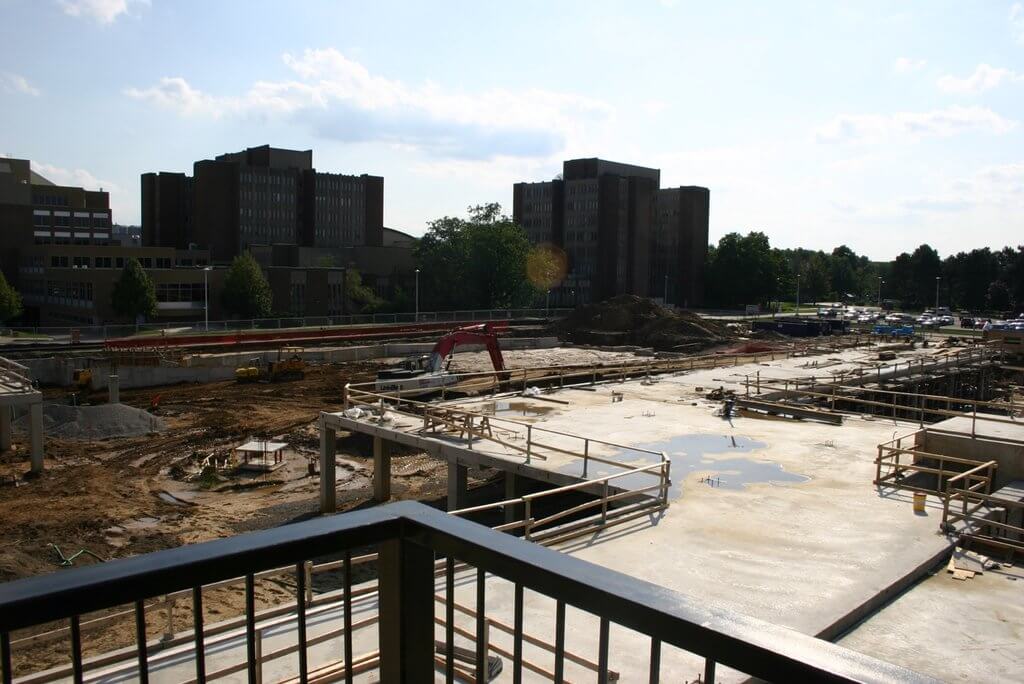
The expansion consumed the footprint of old Les Prince Field, forcing the university to determine where football and soccer would eventually play.
At one stage, there was a proposal to move the stadium away from the main athletic complex, toward the southwest end of campus near the softball diamonds and across Cootes Drive.
Quigley fought to keep it connected.
She wanted varsity student-athletes, recreational users and the general student population to occupy the same broader environment without competing for the same rooms.
That philosophy shaped everything from the location of the stadium to locker rooms and the placement of the Pulse.
Much of that work depended on the people tasked with turning the broader vision into a functional building. Quigley credits Debbie Marinoff-Shupe, then leading recreation, and facilities manager Les Miller with paying close attention to how the new spaces would actually be used — from recreation amenities and programming needs to the way varsity and general student spaces would interact.
Parking became another hurdle. University faculty and staff were concerned about surface lot spaces lost to construction, eventually prompting a significant redesign that added a dedicated parking garage beneath the stadium field and contributed to project delays.
There were architectural changes, temporary locker rooms and teams displaced to other venues.
“It got complicated at times,” Quigley said.
But the principle remained remarkably consistent: build enough capacity so that one group did not have to lose something for another to gain it.
That philosophy also extended beyond campus.
Quigley has long described Athletics & Recreation as a kind of “front door” through which the surrounding community could experience the university.
“Part of how I saw my job was building community and building capacity,” she said.
Foxcroft remembers then-president Peter George making the same point in different terms.
“We’re not going to put a fence around McMaster athletic facilities,” Foxcroft recalled. “We are going to make it open for the community.”
That promise is visible in what DBAC eventually became.
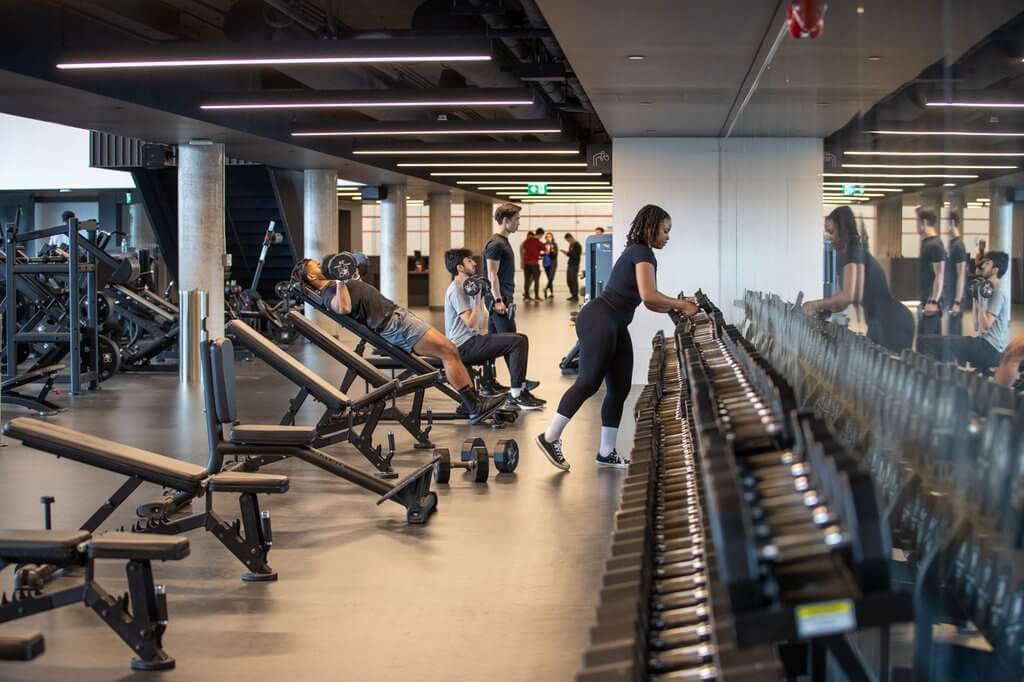
Today, DBAC sits at the centre of a much broader recreation and wellness ecosystem. The facility includes the Pulse Fitness Centre, Sport Hall, indoor track, climbing wall, squash courts, fitness and instructional studios, and the David Braley Sport Medicine and Rehabilitation Centre. Together with aquatics and other recreation spaces across the Athletics & Recreation complex, those facilities support everything from drop-in fitness and intramurals to instructional programs, community recreation, camps and high-performance sport.
Youth camps and the Sport Fitness School program expanded. Community groups gained access to the indoor track, climbing wall, squash courts and fitness facilities. The sport medicine clinic treated people from across Hamilton. The additional space made it easier to host major sporting events, conferences, concerts, and community programming without constantly displacing students.
“This whole campaign was transformational,” Foxcroft said. “Not only for McMaster, but for Hamilton.”
For Cupido, the transformation was deeply personal.
Years after beginning in that small treatment room near Burridge, she walked into the finished Sport Medicine and Rehabilitation Centre.
“It was unbelievable, to be honest,” she said. “It was incredible because it was a lot of years coming, and it was a lot of hard work and a lot of planning and a lot of teamwork.”
The finished centre, she said, was “everything that we wanted it to be and more.”
“I think there’s a legacy,” Cupido said. “From my perspective, what I’m proud about is we left a legacy.”
The scale of DBAC’s impact is also measurable. In 2025–26, more than 26,000 students — roughly 70 per cent of McMaster’s student population — accessed the facility. The Pulse alone recorded nearly 743,000 check-ins from more than 23,000 unique student users, while more than 6,000 students participated in intramural sport during the academic year.
Two decades after it opened, that legacy can sometimes be hardest to appreciate for the people who experience it every day.
Chant-Sehl recently toured the facilities with friends who had attended McMaster with her in the 1990s. Some had never seen what the athletic complex had become. Their reaction?
“Jealous, blown away, proud.”
“Can you imagine,” they asked her, “if this had been here when we were here?”
Chant-Sehl can. She remembers the basement fitness. She remembers when East Aux felt enormous. Then came the original Pulse inside DBAC. In 2019, another generation saw the Student Activity and Fitness (SAFE) Expansion and Renovation project, which has pushed McMaster’s fitness and recreation spaces further again.
“Students who are here now … they don’t know anything different, and that’s the way it should be” she said. “For those of us who have seen the evolution … it’s unbelievable, the evolution in 30 years that I’ve been involved around here.”
Foxcroft feels that passage of time differently.
He still attends McMaster games. At basketball, he sits in the seat once belonging to one of his mentors, Kitch McPherson. Just behind him is a seat commemorating Braley, with whom he spent countless Saturdays watching Marauder teams.
At football, he thinks back to the football ‘stadium’ he once remembers as “crumbling” and looks around at what stands there now — Ron Joyce Stadium, a 5,500 seat multi-purpose facility, that opened in 2008.
“It’s emotional for me,” he said.
Maybe that is the clearest measure of what was built.
Twenty years ago, hundreds of students stood in a line around a brand-new gymnasium carrying badminton racquets, eager to use a building they had helped make possible.
Years earlier, another group of students had voted to help pay for it knowing many of them would never get that chance.
They were hardly alone. Donors gave at every level, from transformational gifts to the few dollars people could spare. Staff fought for the students through redesigns and operational headaches. University leaders defended a vision when easier compromises were available. Leaders travelled the world for inspiration, because if McMaster was going to call something world-class, the people behind it believed it ought to be, world-class.
Again and again, people invested time, money and energy in something whose greatest benefits would belong to people they might never meet.
That, more than the concrete or glass, may be the foundation DBAC was really built on.
They were building toward an idea bigger than a building; enough space for recreation and varsity athletics to co-exist. A place for health, performance, teaching and research. And a university that could invite everyone in rather than put a fence around itself. Something for everyone.
And when the doors finally opened, the students came. 20 years later, recreation at McMaster University is as strong as ever.